
HABITUS Tracing Paint's Ancient Purpose - and It's Modern Cost to Our Health
Over the last few weeks, I have been reading a book about how the colors we choose can reveal in-depth details about a person’s personality and even indicate which organs or body systems aren’t functioning properly.
Our minds seek out colors that are healing to us, whether we are aware of it or not. I haven’t had the pleasure of finishing the book yet, but color and how we use the power of color have been on my mind lately.
I recently bought an old serving hutch and have intended to refinish and paint it a lovely English plum color. My DIY dreams have taken a great deal longer to achieve than the 30-second video we see pop up on our social media feeds. Still, nothing in design or in life that is great is ever easily achieved. Also, most people I share the color with absolutely love the deep, warm purple that I am planning to use.

The cabinet itself seems as though it was finished in Willy Wonka’s chocolate factory on the gobstopper line. The layers of paint, stain, and clear coat seem to be endless.
While I work at doing away with the old and longingly think about the new, I note how abrasive the paint peeler cream has to be to even touch some of the layers.
The chemical smell and the paint peeling off like a melted plastic goop really had me wondering if I should even paint the cabinet at all when I was finished sanding.
When looking at paint colors, I had a brief discussion with a local Sherwin-Williams paint representative who told me about a new, no or low-toxic paint that they had just released on the market.
I was grateful for the information, but then I started to wonder, why are they knowingly selling anything toxic to begin with? Why is the non-toxic option only becoming available in 2025?
Does the general public know when they leave a paint store that they might be filling their home with toxins?
With my affinity for the lessons history can teach us and also my inability to stop wondering if I can make everything myself from scratch, I started to research paint and what made paint toxic throughout history.
As I write the HABITUS book, I started off with a chapter specifically on an overview of the development of health-improving aspects in our structures throughout known human history.
It seems our current homes, from layout to aesthetic, have more in common with ancient structures and ways of living than we really realize.
PAINT’S ANCIENT PURPOSE
Prehistoric Paints (40,000-10,000 BCE)
Is the creation of paint a human instinct? Anthropologists, archaeologists, and psychologists would say: yes, the creation of paint is very close to a human instinct as it appears across cultures, continents, over tens of thousands of years, suggesting that it is not an accident but a deep expression of being human.
Color perception is primal. Humans evolved with highly sensitive color vision compared to many animals, especially to certain colors. Humans are inherently sensitive to the colors red and yellow, and while they are not innately poisonous, they are warning colors in nature for many venomous snakes, frogs, and insects.
These species fall under the concept of aposematism or displaying bright colors in distinctive patterns to warn off predators.
Imagine the summer air was hot and thick, teaming with insects and biting flies. You are a member of a tribe of hunter-gatherers that takes shelter for the night after a few days of hunting.
The insects seem to swarm during certain times of the day, making resting almost impossible. Your tribe members are restless in sleep and are constantly tending to the wounds and bites received during the day and night.
As you reach a point of desperation while watching the herd from afar, you notice a few of the bison rolling in the red dirt of the plains. You notice how the flies around them circle but do not land for a bite.
You walk to the riverbank nearby, where you had seen some similar chunks of minerals, and crumble the ochre you find in your hand.
The only commodity you have to mix and adhere this mineral with to your skin is some animal fat from your last kill. You mix it and quickly paste it across your sore skin.
The fat is moisturizing and soothing, but as you walk back to camp, the insects don’t seem to land on you. You rest easy for the first time in days overnight, and the next morning, your tribe members work to create enough paint to treat the rest of your group.
The paint mixture is even added to the opening to a mouth of a cave you rest in the next night, keeping even more insects at bay.
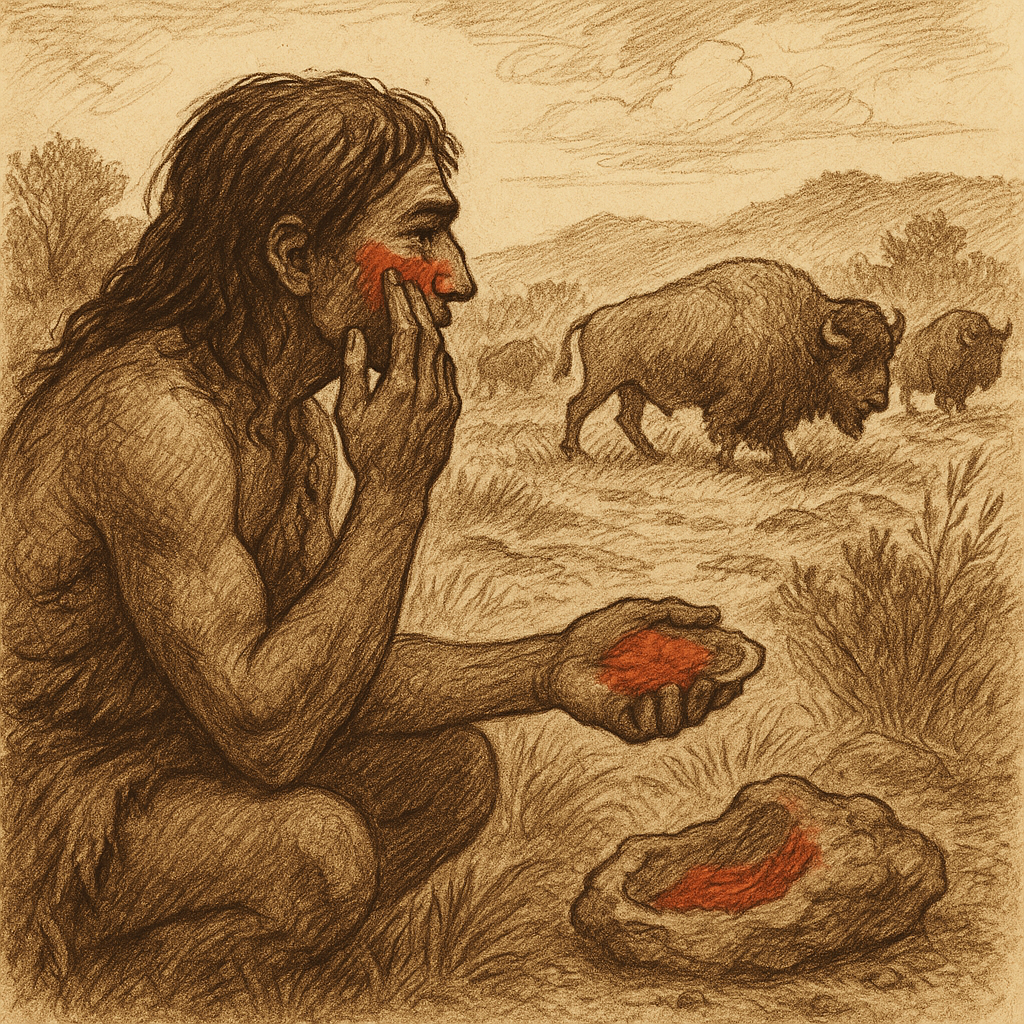
This paint became more than just a color, but functioned as a shield and medicine that the tribe would collect and carry with them as they tracked the herd. The red on their skin was now not only for their survival and comfort, but a sign of wisdom.
Many note that cave paintings in Africa, Europe, Asia, and the Americas are a form of the first interior design. The cave paintings of Lascaux (France) and Altamira (Spain) come to mind, using charcoal, red/yellow ochre (iron oxides), chalk, and clay mixed with animal fat, blood, or tree sap.
The pigments used were naturally occurring minerals that were generally safe, although inhaling the pigment dust could cause lung irritation.
Ancient Civilizations (3,000 BCE - 500 CE)
Imagine you start your morning listening to the sounds of the Nile River in your stone home in Deir el-Medina. Your commute starts by meeting up with other artisans you are working with in the Valley of Kings. You walk together over desert paths for about an hour each morning to reach the tomb you are currently working on to consecrate the dead.
Entering the tomb, you pass the guards that prevent grave robbers from ruining your work, and feel a sense of comfort as you settle on the cooling floor.
You quickly begin work grinding down brilliant blue azurite until your hands ache. This blue pigment will be used to cover the ceiling with stars. The azurite is precious and is only fit for a Pharaoh’s tomb.
This particular tomb belongs to Seti, and the art you create will light his path through the sky when he journeys to the gods.
The overseer checks on your group and urges that every wall must be alive with color. Next, you mix cinnabar for the sun’s red disk, malachite for Osiris’s skin, and yellow orpiment for Ra’s eternal light.
You mix the fine powders with egg and plaster. The powders sting your nose and fill your chest with a heavy feeling, but you breathe them in as if they are the gods themselves entering your body.
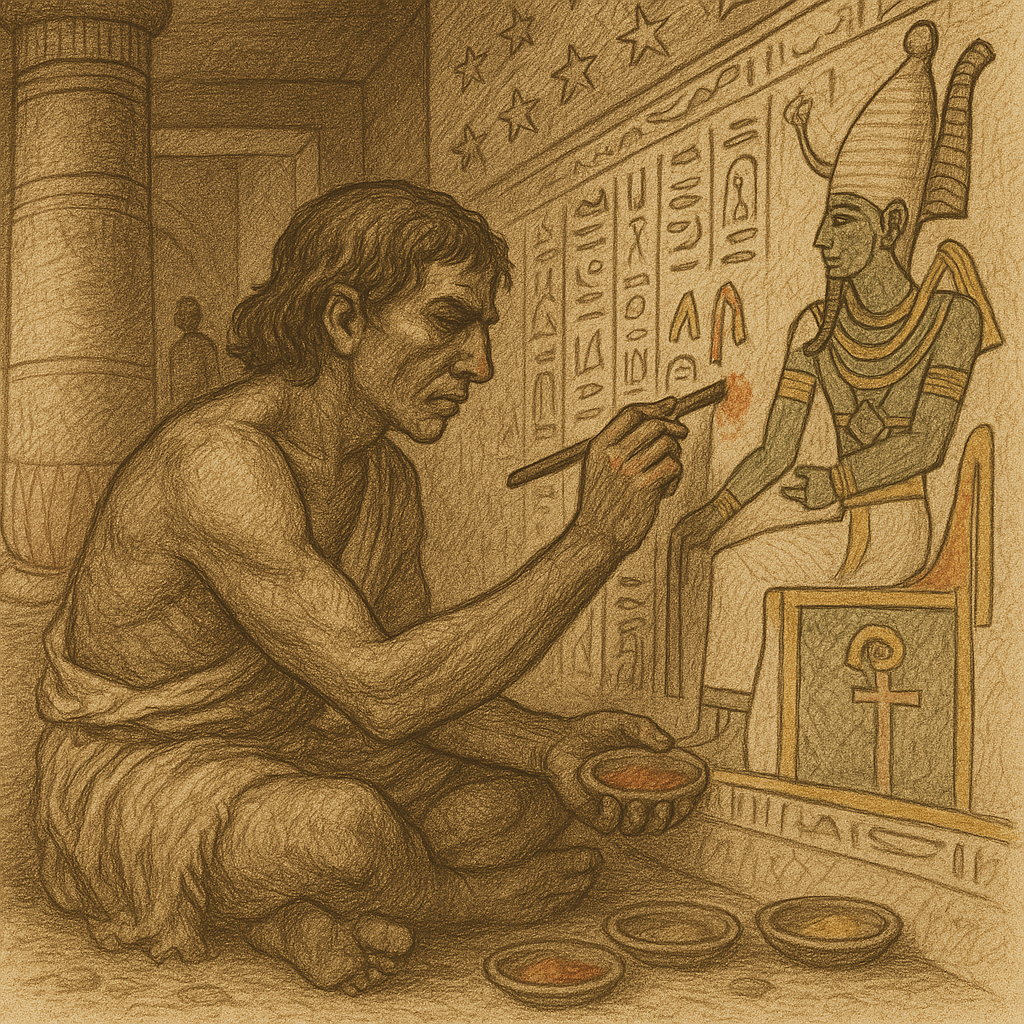
When you begin to brush the pigments across the plaster, you feel pride, but also, in the back of your mind, you have a sense of dread. You are proud that your work will guide the Pharaoh to eternity.
Your eyes lose focus a little, and you are reminded that your vision is weakening. Your hands are always stained with pigments, and you can never wash out the cinnabar and malachite. Your breaths feel heavier and you feel weaker than you used to.
Still, when you lay your marks on the wall and ceiling, you know that a part of you will live in this tomb in eternity. You will join Seti in eternity through a world painted brighter than life itself.
The Egyptians, Greeks, and Romans expanded the use of lead-based paint to include white lead and red lead for their durability and brightness.
They also used red cinnabar, highly prized in the ancient world, which is mercury sulfide. The lead paint caused neurological, reproductive, and developmental issues, while the cinnabar caused lung irritation, coughing, difficulty breathing, memory loss, and difficulty speaking.
These pigments were as beautiful as they were deadly. These paints lasted a millennium, but with huge health costs to the artisans who used them to glorify the dead.
FROM TOXIC TO TIMELESS
Cave handprints, red ochre burials, animal paintings, and body markings appear in unconnected cultures, suggesting that paint-making was not “taught” globally.
Making paint arose like music, language, and fire wherever humans appeared. Paint satisfies layers of needs like protection, for social identity, symbolic, ritual, and aesthetics.
Even children, without being taught, smear pigment, mark surfaces, and decorate themselves when materials are given, suggesting that using paint is embedded in human development.
As I prime the canvas of history, both on my cabinet and in my research for HABITIS, it paints a clearer picture that paint has always carried more meaning than color alone.
It has been medicine, a warning, beauty, and danger all at once. The story of paint is not just about aesthetics; it is about survival, ingenuity, health, and a symbol of wisdom.
In the days and weeks ahead, I’ll be exploring how toxic paints shape our built world, and more importantly, how we can reclaim paint’s ancient purpose by reviewing and using non-toxic options.
Stay tuned for the next deep dive into the history of paint and discover safer, healthier alternatives through HABITUS ELEMENTUS.
